

The scriptures immortalise the symbol and significance of the Savior’s hands. In His atoning sacrifice, His hands were pierced by nails to affix Him to the cross. After His Resurrection, He appeared to His disciples in a perfect body, but the prints in His hands remain as a reminder of His infinite sacrifice.
~ Elder Villar, His Hand Ready to Help Us, October 2024 General Conference
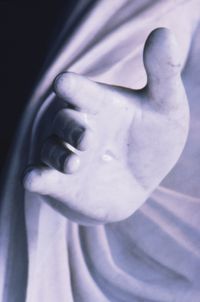
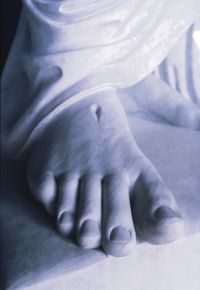
Christianity rests upon a paradox, to the world: the Son of God became like a mortal man, and died by crucifixion, one of the most torturous and shameful forms of death. He was betrayed by His countrymen, the Jews, and put to death by the Romans, their conquerors. As Paul wrote, “we preach Christ crucified, unto the Jews a stumblingblock, and unto the Greeks foolishness” (1 Corinthians 1:23). To the world, this looks like failure.
But what others see as failure for Jesus Christ was His triumph. He has chosen to retain the marks of that seeming failure, because He is not ashamed of it. By it, He completed the work His Father gave Him to do. He knows that it is extreme comfort to us; that it testifies of His infinite love towards us; that it reassures us He is to be depended upon.
I have graven thee upon the palms of my hands; thy walls are continually before me.
~ Isaiah 49:16
Look unto me in every thought; doubt not, fear not. Behold the wounds which pierced my side, and also the prints of the nails in my hands and feet; be faithful, keep my commandments, and ye shall inherit the kingdom of heaven.
~ Doctrine & Covenants 6:36-7
He received those marks for us. He bled for us. He suffered exruciating pain, for us. He retains the marks in His body, not to condemn us or make us feel guilty, but to prove that He is, really, our Saviour. That He has, really, done what the scriptures say He has. That salvation is real, and He has, really, overcome death – and everything that is fallen and imperfect about our mortal lives.

Jesus Christ invites each person among the Nephite crowd to come and feel the wounds in his hands and feet, and know that He is Christ.
We can confidently disregard brokenness in any way disqualifying us from heavenly love—every time we sing the hymn that reminds us that our beloved and flawless Saviour chose to be “bruised, broken, [and] torn for us,” every time we take broken bread. Surely Jesus removes all shame from the broken. Through His brokenness, He became perfect, and He can make us perfect in spite of our brokenness. Broken, lonely, torn, and bruised He was—and we may feel we are—but separated from the love of God we are not.
~ Elder Karl D. Hirst, God’s Favourite, October 2024 General Conference
What looks and feels like brokenness to us is not irredeemable, nor does it make us hopeless and unlovable. It makes us human, and in need of saving – by the One who has eternally pledged to be our Saviour, and proven it by all He has done. Our marks of seeming failure – whether in the world’s eyes or our own, natural mind’s eyes – also become symbols of triumph and hope. Wounds we’ve received in the working-out of our salvation, as we come up against all sorts of difficult and unfair circumstances that try our faith and refine our souls; wounds we’ve received in our struggle with the natural man and the powers of darkness which seek to infect our minds. Our wounds are the evidence of our determination to overcome, and of the grace of God, who is saving us, line upon line and blessing upon blessing.
What looks like straw and mud to us can, in the hands of our loving and masterful God, be turned to gold. The process has already begun; it’s been happening all the while.
Discover more from Peaceable Treasures
Subscribe to get the latest posts sent to your email.
 Peaceable Treasures